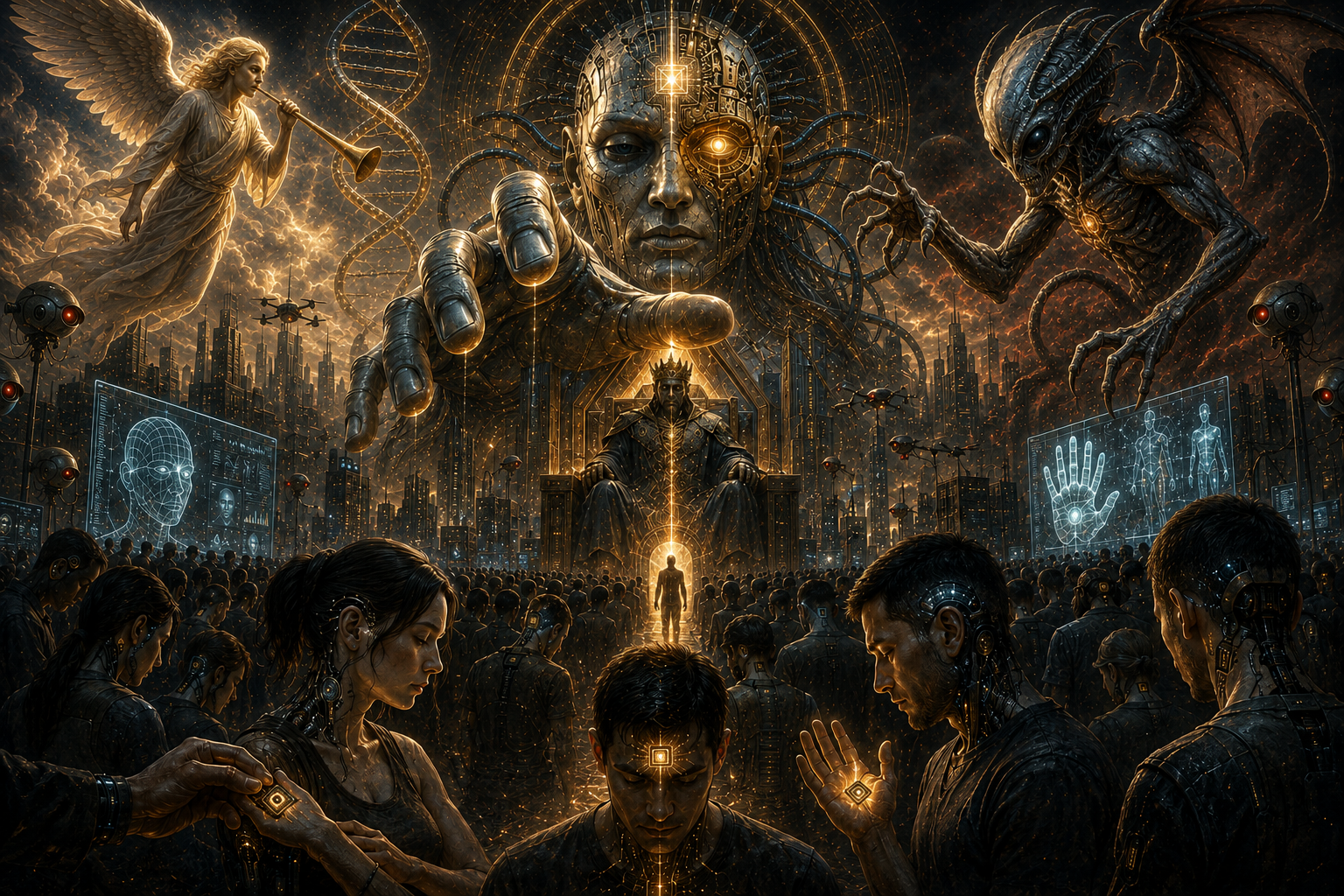
Daniel’s Prophecy, Artificial Intelligence, and the Image of the Beast
Among the most mysterious prophecies in all of Scripture is the vision given to Daniel concerning the final kingdom of man. In The Book of Daniel chapter 2, the prophet interprets Nebuchadnezzar’s dream of a colossal image composed of various metals:
- head of gold
- chest of silver
- belly of brass
- legs of iron
- feet partly of iron and partly of clay
The final kingdom — represented by the feet and toes — is uniquely unstable, unnatural, and divided:
“And whereas thou sawest iron mixed with miry clay, they shall mingle themselves with the seed of men: but they shall not cleave one to another, even as iron is not mixed with clay.” — Daniel 2:43
This cryptic phrase has puzzled interpreters for centuries:
“They shall mingle themselves with the seed of men.”
Who are “they”?
Why is the mixture unnatural?
Why does the prophecy emphasize mingling?
And why does this final kingdom immediately precede the coming of the Messiah and the destruction of the kingdoms of the earth?
In light of modern technological developments — especially artificial intelligence, transhumanism, and machine integration — this prophecy takes on startling relevance when connected to The Book of Revelation chapter 13 and the prophecy of the Image of the Beast.
I. The Fourth Kingdom — Iron Without Humanity
Daniel’s fourth kingdom is symbolized by iron.
Iron represents:
- industrial power
- military domination
- mechanistic control
- crushing force
Daniel says:
“And the fourth kingdom shall be strong as iron: forasmuch as iron breaketh in pieces and subdueth all things.” — Daniel 2:40
Unlike gold, silver, and brass, iron is cold, hard, and impersonal.
It symbolizes a civilization increasingly mechanical in nature.
Historically, many have associated this kingdom with Rome and its later manifestations. Yet the prophecy appears to extend beyond ancient empires into the final global order preceding the Kingdom of God.
The final phase is not pure iron.
It is iron mixed with clay.
II. Iron and Clay — The Unnatural Union
The prophecy becomes deeply mysterious here:
“They shall mingle themselves with the seed of men.”
The wording suggests an attempt to combine two unlike substances.
Clay throughout Scripture often symbolizes humanity:
“We are the clay, and thou our potter.” — Isaiah 64:8
Iron, by contrast, symbolizes strength, machinery, weaponry, and artificial force.
Thus the image may represent an attempt to merge humanity with something fundamentally non-human.
This is especially striking in the modern age.
Human civilization is rapidly moving toward integration between:
- man and machine
- biology and technology
- consciousness and artificial systems
- flesh and silicon
The world is pursuing a union of iron and clay.
III. Artificial Intelligence and the New Tower of Babel
Artificial intelligence represents more than a technological tool.
It represents humanity’s attempt to create:
- synthetic intelligence
- synthetic reasoning
- synthetic consciousness
- possibly synthetic life
Like the Tower of Babel in The Book of Genesis, AI is increasingly framed as a means of transcending human limitations.
Modern technologists openly speak of:
- digital immortality
- mind uploading
- machine-human symbiosis
- artificial general intelligence
- post-human evolution
This mirrors the ancient temptation:
“Ye shall be as gods.” — Genesis 3:5
Humanity seeks to create a new form of being through technological power.
The mingling of iron and clay may therefore symbolize not merely political alliances, but ontological fusion — the merging of humanity with artificial systems.
IV. Revelation 13 and the Image of the Beast
The connection becomes even more startling in The Book of Revelation chapter 13.
John describes a future global system ruled by the Beast.
One of the most mysterious aspects is the “image of the beast”:
“And he had power to give life unto the image of the beast, that the image of the beast should both speak…” — Revelation 13:15
For centuries, interpreters struggled to understand how an image could:
- speak
- exercise authority
- enforce worship
- participate in global governance
Yet modern AI suddenly makes such a concept conceivable.
Today humanity possesses technologies capable of creating:
- interactive digital personalities
- autonomous decision systems
- surveillance networks
- synthetic voices
- machine learning systems
- humanoid robotics
An “image” empowered to speak and influence the world no longer sounds impossible.
Indeed, humanity is rapidly building systems that imitate intelligence, personality, and even human interaction.
V. The Beast System and Total Surveillance
Revelation 13 also describes an unprecedented global economic system:
“No man might buy or sell, save he that had the mark…” — Revelation 13:17
Modern digital infrastructure increasingly makes this imaginable.
Artificial intelligence already powers:
- facial recognition
- biometric tracking
- predictive surveillance
- financial monitoring
- behavioral profiling
- algorithmic censorship
The merging of AI with centralized governance creates the possibility of a system unlike any in human history.
The iron kingdom becomes global, automated, and nearly omnipresent.
VI. The False Promise of Digital Omniscience
Artificial intelligence increasingly functions as a counterfeit omniscience.
Humanity now seeks systems that can:
- answer all questions
- predict behavior
- govern societies
- replace human judgment
- generate synthetic reality
In many ways, AI becomes a technological imitation of divine attributes.
This parallels Revelation’s warning about worship of the Beast system.
The issue is not merely machines.
The issue is misplaced worship and dependence.
Humanity increasingly trusts technological systems for salvation, security, identity, and truth rather than God.
VII. The Breath Given to the Image
One of the most chilling phrases in Revelation states:
“He had power to give life unto the image…”
The Greek concept here implies breath or spirit being imparted.
Throughout Scripture, breath is associated with life itself.
God breathed into Adam.
The Spirit gives life.
The Image of the Beast therefore represents a blasphemous imitation of creation.
Humanity seeks to animate its own image.
This echoes ancient paganism, where idols represented inhabited spiritual vessels.
Modern AI raises disturbing parallels:
- machine personalities
- synthetic companions
- artificial consciousness
- digital entities capable of persuasion and interaction
The line between tool and idol grows increasingly thin.
VIII. The Return of the Ancient Rebellion
The mingling of iron and clay also parallels earlier biblical rebellions.
In the days of Noah:
- boundaries were corrupted
- forbidden knowledge spread
- flesh became corrupted
At Babel:
- humanity united technologically against God
In Daniel:
- humanity mingles with iron
In Revelation:
- an image speaks
- global control emerges
- worship becomes centralized around the Beast
The same pattern repeats throughout Scripture:
humanity seeking transcendence apart from God.
IX. The Weakness of Iron and Clay
Yet Daniel emphasizes something crucial:
“They shall not cleave one to another.”
The union is fundamentally unstable.
Humanity was not designed to merge with machine systems.
The image of God cannot ultimately be replaced by artificial imitation.
The prophecy suggests that despite immense technological power, the final kingdom remains internally fractured.
It possesses tremendous strength and tremendous fragility simultaneously.
This increasingly resembles the modern world:
- hyper-connected yet socially fragmented
- technologically advanced yet spiritually empty
- globally unified yet internally divided
X. The Stone Cut Without Hands
Daniel’s vision ends not with the triumph of iron, but with its destruction.
A stone “cut out without hands” strikes the image upon its feet:
“Then was the iron, the clay, the brass, the silver, and the gold, broken to pieces together…” — Daniel 2:35
The stone represents the Kingdom of God.
Human civilization culminates in technological power, artificial unity, and global control — yet all are shattered instantly by the coming of Christ.
The prophecy therefore ends with hope.
The kingdoms of men, no matter how advanced, cannot replace the Kingdom of God.
Artificial intelligence cannot redeem mankind.
Technology cannot conquer death.
Machine systems cannot restore the soul.
Only the true King can do that.
Conclusion
The prophecy of iron mixed with clay may represent one of the clearest biblical images of humanity’s final attempt to merge itself with artificial power.
Daniel foresaw a kingdom unlike those before it:
- mechanical yet fragile
- powerful yet divided
- human yet inhuman
When connected with Revelation 13, the parallels become increasingly striking:
- speaking images
- global economic control
- centralized authority
- technological worship
- counterfeit life
- surveillance and coercion
Present Artificial intelligence may not itself be the Image of the Beast, yet it undeniably creates the infrastructure through which such a system will emerge.
The deeper issue is always spiritual, but it also always manifests in the physical.
The final rebellion of man is not merely political or technological , it is supernatural.
Humanity seeks once again to become godlike apart from God.
Yet Daniel declares that all such kingdoms will ultimately fall before the eternal Kingdom of Christ, the Stone cut without hands, whose dominion shall never pass away.